Posted by Shazarch on 18 Mar 2021
Regia
7th century BCE, Roman Forum, Rome
Archaeological site
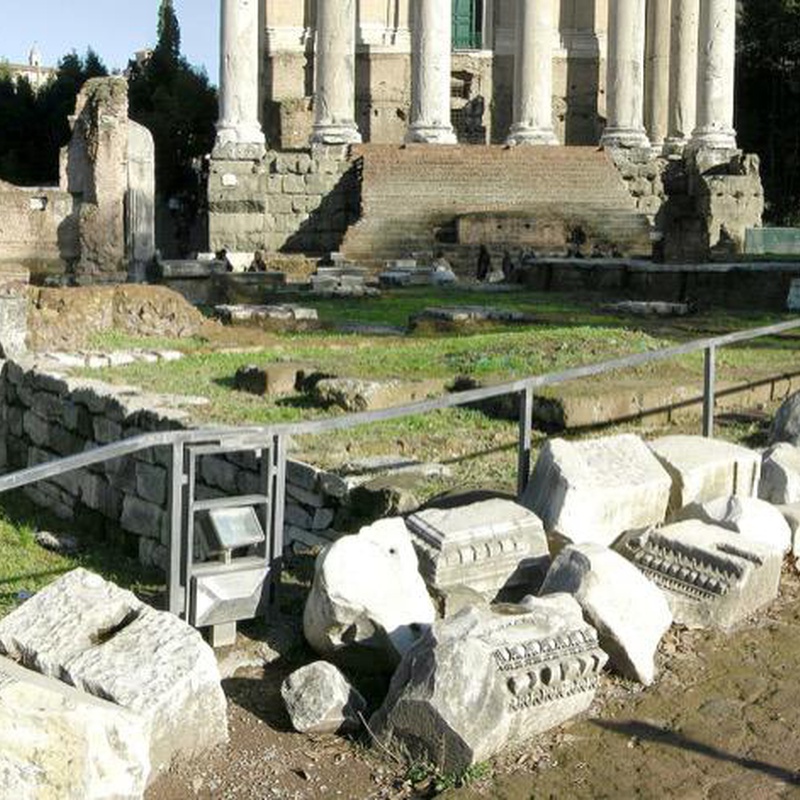
The origins of the Regia date back to Numa Pompilius, the second king of Rome, who according to Gaius Julius Solinus, first lived on the Quirinal Hill, then near the Temple of Vesta. The building ordered by the sovereign flanked a major artery of the archaic city, the Sacra Via, at the edge of the Roman Forum. The Regia defined the short eastern side of this square, at least until it was overshadowed by the Temple of Caesar, which together with the Arch of Augustus, modified the configuration of this part of the Forum. The first construction of the Regia in masonry dates to the seventh century BC. According to excavations and stratigraphic analysis, it replaced a pre-existing group of huts that probably dated to the previous century. Due to fires and natural disasters, it was rebuilt several times in the course of the sixth century BC. Its structure was modified from time to time up to the early fifth century BC, when it achieved a stable plan. In the republican period further modifications were made. In 36 BC, Gnaeus Domitian Calvinus made a sumptuous restoration with marble, remains of which survive today. The Regia was probably composed of two parts: the trapezoid space of the courtyard with double portico and a central well, possibly for storing grain, and a structure with a rectangular floor plan on the southern side that contained a sequence of three rooms. The central room was the entrance; the smaller lateral room contained the shrine of Ops Consiva, goddess of agricultural abundance and granaries; the larger room on the opposite side was a shrine with a circular altar dedicated to Mars. The persistence of a small compact archaic building of irregular form indicates the symbolic meaning ascribed to the Regia. It may allude to the sacred nature of the floor plan. In De Verborum Significatu, Sestus Pompeius Festus writes 'Regia domus, ubi rex habitat', or that the Regia was where the king of Rome lived. However, there are various interpretations. The Regia may have been above all the place of representation of the kings, linked to their role of pontifex maximus, instituted by Numa Pompilius himself. According to some scholars, the Regia can be considered part of a larger complex that included the Atrium Vestae and the Domus Regis Sacrorum. On deposition of the last king and foundation of the Republic in 509 BC, the figure of rex sacrorum, or king of the sacred rites, was instituted in the context of the Roman magistracy, which was responsible for religious functions previously conducted by the king. Under the Republic, the Regia became more clearly a place of worship and administration of the rex sacrorum, the pontifex maximus and the vestals. It was not where they lived, although it maintained certain elements of the domus. There was a change in its relationship with its context, namely the Temple of Vesta, the Atrium Vestae, the Domus Regis Sacrorum (later Domus Publica). As observed by Filippo Coarelli (Il Foro Romano, Periodo arcaico, 1983), 'There is a link between building work (...) and the constitutional history of Rome, the transition from monarchy to the Republic, when the powers of the king were distributed among new institutional and religious figure'. Separation of the Regia then became 'a political act of the young Republic, which on a monumental plane manifested as fragmentation of reigning power: after that the building became a fanum in which rites previously linked to the king were artificially kept alive'. Archaic ceremonies, such as the agonium, celebrated in January by sacrificing a ram in the Regia, the queen's sacrifice to Juno at the calends or the October Horse, a rite to Mars which took place in the Campus Martius with a horse race and concluded in the Regia, where the tail of the sacrificial horse was brought so that its blood could fuel the sacred fire to the god. These were ceremonies or private rites associated with the king, which continued and acquired a public character in the republican period. Even on foundation of the empire, sacred objects such as the lances and shields carried in procession by the Salii or priests of Mars, continued to be kept in the shrine to Mars, whereas sacrificial instruments were kept in the shrine to Ops. The college of pontifices met in the Regia and their archives were probably housed there. As recalled by Appian, the body of Julius Caesar was buried in front of the Regia. Caesar had been pontifex maximus in the Regia. This role was subsequently attributed to the emperors from Augustus in 12 BC until 376 AD. The Temple of Caesar was built right in front of the Regia. Next to it, on the Sacra Via, Antoninus Pius emphasised continuity with king Numa Pompilius and archaic Rome by erecting the temple first dedicated to his deified wife, the divine Faustina, then on his death, to himself, as divine Antoninus.